Indigo Kids Podolí
Bilingual Elementary and Kindergarten School
Bilingual Education Program
Indigo Kids Elementary School builds its curriculum on the foundation of the new Czech Framework Educational Program (FEP), which emphasizes the development of key competences, cross-curricular connections, and active student engagement in the learning process.
Unlike the traditional approach, long focused primarily on the transmission of encyclopedic knowledge, the new FEP highlights the ability of children to learn in context, to develop critical thinking, creativity, collaboration, and responsibility. Education is therefore oriented toward preparing children to succeed in a rapidly changing world and to apply their knowledge and skills in real-life situations.
Our school fully embraces this shift and intentionally creates an environment aligned with the principles of modern pedagogy – we integrate subjects, work through projects, focus on formative assessment, and base everything on values that nurture the whole child, not just academic performance. Indigo Kids embodies the belief that a school should not only be a place to acquire knowledge but also a space for life, collaboration, and personal growth.
Preparing for the Future
Indigo Kids is a private multi-age elementary school founded on modern educational principles with a focus on the holistic development of the child. Students learn in an environment that fosters individuality, cooperation, and joy of discovery.
At the same time, our teaching is designed so that children are well prepared to successfully pass entrance exams for Czech and international eight-year grammar schools or transition smoothly to the upper primary level. In the 4th and 5th grades, special emphasis is placed on systematic preparation for entrance exams to selective schools, so families do not need to seek additional tutoring – everything is provided directly within our school.
Our Core Values
- Development of soft skills – communication, collaboration, problem-solving, critical thinking, self-reflection, time management, resilience, empathy, and presentation skills
- High-quality, professional education, built on teacher expertise and innovative methods
- A safe and supportive environment for every child
- Trust and cooperation between teachers, students, and families
- Respect for the individuality and uniqueness of each learner
- Formative assessment – no grades, but meaningful descriptive feedback
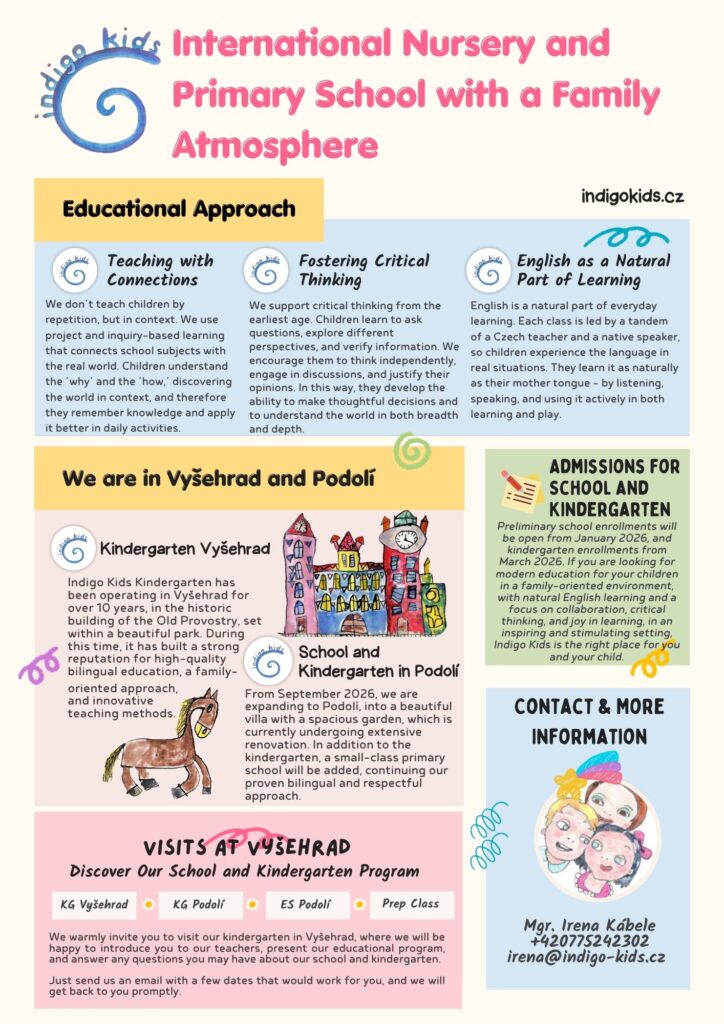
Although Czech is the primary language of instruction, the entire concept is built around natural English immersion – both as a language of communication and as a medium of learning. Each class is led by a tandem of teachers: a Czech teacher and a native English speaker.
Since classes consist of mixed-age groups (grades 1–5), we apply the proven principles of Universal Design for Learning (UDL). This approach ensures that every child can learn in their own zone of proximal development and create individualized learning outcomes based on their knowledge and skills.
Reading and Writing
Children at Indigo Kids learn to read and write using the phonics-based Genetic Method, which builds reading skills naturally – by recognizing individual sounds and blending them into words.
For handwriting, we use Comenia Script, a modern, universal, and simpler script compared to traditional cursive. While children are introduced to cursive and learn to read it, they are not required to write in it unless they show personal interest.
Mathematics
Mathematics at Indigo Kids is taught using the Hejného Method, which emphasizes exploration, collaboration, and discovery. Children learn mathematical concepts through real-life contexts, structured learning environments, and joint problem-solving. The focus is not just on the correct answer but on understanding the process and building logical reasoning.
English Language
English learning takes place on two levels:
- Daily natural communication with a native English teacher who co-leads the class, so children absorb the language in authentic contexts – similar to how they learn their mother tongue.
- CLIL (Content and Language Integrated Learning): subject content is taught partly in English. For example, students solve math problems in English, describe science experiments, or follow instructions in PE. This way, English becomes a tool for discovering the world, not just a separate subject.
In addition, students gradually build a foundation in English grammar, so they learn to both use and understand the language accurately.
Informatics and Digital Competence
From grade 1, children are safely introduced to the world of technology. They have access to school tablets and computers for learning and projects.
They start programming with Emil, an interactive educational game that teaches algorithmic thinking step by step. Later, they move on to Scratch, where they create their own animations, stories, and games. Students also use AI tools for research, text creation, and design – always guided to use them meaningfully and responsibly.
The school, however, is completely mobile-free – children do not use smartphones during classes or breaks, in line with research recommending mobile phone use only after about age 13.
Other Learning Areas
Subjects such as Social Studies, Science, Arts and Culture, Health and Safety, Personal and Career Education, and Geography are integrated across the curriculum. We use modern approaches like project-based learning, inquiry-based learning, Montessori, forest and experiential pedagogy.
Learning is deeply connected to real life:
- excursions to museums, theaters, companies, and nature
- project days focused on current social topics
- outdoor education and community involvement
This ensures that knowledge is not abstract but directly tied to children’s everyday experiences.
Sports and Physical Education
We emphasize healthy lifestyles and physical habits. Students use the school garden for free play and movement and attend nearby sports facilities and gyms for structured activities.
Every year we organize swimming lessons, skiing trips, and skating courses, providing children with both fun and valuable skills. Alongside this, children learn about healthy eating, rest, stress management, and balance, developing lifelong habits that support well-being.
Additional Languages
Indigo Kids also offers optional Spanish lessons with a native speaker. Children learn through songs, games, and simple conversations, gaining not only language basics but also cultural openness.
Democracy in Practice
Democratic education is embedded in daily life through the School Assembly, where all children and teachers participate. Together they:
- propose and approve school rules
- resolve conflicts and seek fair solutions
- plan school events and projects
- provide feedback and suggest improvements
Through this, students practice communication, empathy, collaboration, and civic responsibility, experiencing firsthand what democracy means.
Mentoring
Each child meets with a mentor at least twice a month. Mentoring develops metacognition – the ability to reflect on how one learns. Children learn to plan their goals, monitor progress, and take responsibility for their learning, building skills that will serve them throughout life.
Parent Partnership
Parents are an integral part of the Indigo Kids community. They are welcome to observe classes, join activities, or simply spend time at school. Monthly community breakfasts and morning coffees offer space for dialogue and connection.
We also use tripartite meetings (student–parent–teacher), where children present their own learning and progress, supported by feedback from both parents and teachers. This fosters accountability, confidence, and a true partnership between school and family.
Community Involvement
Indigo Kids is actively engaged in the local community. We host open events such as fairs, neighborhood celebrations, and theater performances. Students help maintain and beautify the area around the school – planting trees, caring for the garden, and joining ecological projects.
This teaches children that a school is not an isolated place but a vital part of the community, where everyone can contribute to a better environment and stronger relationships.